Season 1, Episode 1
Keep Moving Forward with Taylor Talbot
A Paralympic athlete on losing her sight, finding her sport, and choosing to keep going.
Released: November 5, 2026
About this episode
At 14, Taylor Talbot realized she was going blind. She had a choice to make. She could let it hold her back, or she could keep moving forward.
In the first episode of Access Forward, Taylor shares the story of how a picture in a Spanish textbook introduced her to the Paralympics, how a coach who believed in her more than she believed in herself changed her life, and how one jump off a dock in Chicago turned a sprinter into a Paralympic triathlete.
Show Notes:
- The choice Taylor made at 14 to change her perspective
- How a Spanish class introduced her to the Paralympics
- Meeting coach Joaquim Cruz and racing the 100 and 400 meters at the 2021 Paralympic Games
- Leaving the training center and switching from sprinting to Paralympic triathlon
- What it means to race tethered to a guide through the swim, bike, and run
- Her first triathlon, and the veteran's coin she values more than any medal
- Why none of us can do life alone
Your host
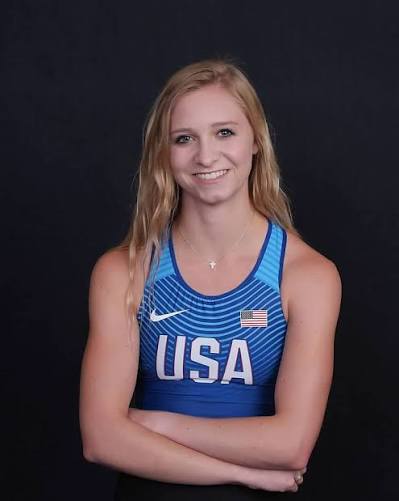
Taylor Talbot
Host, Paralympic triathlete
Taylor Talbot is a Paralympic athlete who has been losing her sight since early childhood. She competed in the 100 and 400 meters at the 2021 Paralympic Games, then switched to Paralympic triathlon, where she has won a World Cup gold medal and raced in the World Championship Series. She trains in Tucson, Arizona.
Full transcript
This transcript has been lightly edited for readability.
Hello, and you're listening to Access Forward, Inspired by Pope Tech. I'm your host, Taylor Talbot. Sometimes we need somebody who believes in us more than we believe in ourselves. And as a 14-year-old girl who was about to go into a brand new high school with only 88 kids in her graduating class, I was super, super shy and reserved at the time. I mean, it was hard enough as it is, but on top of all of that, I realized that I was going to lose my eyesight. I was going blind. And although I had been going blind since age two and had been diagnosed with a very rare and degenerative eye disease at age eight, this realization hadn't hit me until I had kind of grown up a little bit because when you're younger, you don't understand certain things.
I was too busy playing with my friends and enjoying my time just being a kid. And then when I got into high school, things kind of changed a little bit and I had to face reality. And I realized that I had this choice in front of me. I could either change my perspective from, oh, woe is me? This is too hard. I can't get around it. How am I going to be able to do anything? How am I going to be able to see the world to let's see what I can do about this to overcome this challenge? Maybe it's not as bad as it seems.
Maybe I can put a purpose with this and turn something difficult into something great into something good that can not only inspire others, but it can help me become a better person. It can help me reach my dreams. Maybe there is a way for me to see the world. And I realized that this could be possible even though I didn't see the road ahead. There was no way for me to see what was going to happen next. But I knew that if I just kept going, that if I kept moving forward, no matter how many times I got hit or knocked down or how many times I felt lonely, that I was going through this by myself, no matter how many times I felt sad that there might come a day where I wouldn't be able to see my friends and family's faces again.
No matter how many times I thought of that, no matter how many times that beat me down, I vowed to myself that I was going to keep moving forward. And as a very young girl, I had kind of been taught this already because I had been doing sports since, basically ever since I could walk. My parents had both been track and field athletes. I think were pretty much all their lives and into high school and college and they met on their college track team and I was their first born kid. So naturally, I was out on the track running since the age of one. And so I had been taught to do sports my whole life.
I had been taught to be disciplined and to be strong and to overcome hard things and to push through pain. And track and field became one of those outlets, especially when I was in high school. The main outlet at the time had been music, but when the Paralympics found me, everything kind of just shifted. And I realized that track and field was my chance to be able to see the world and to grow as a person, to become more confident in myself and to be able to navigate and access the world even though I had to adapt and do things differently. During my freshman year of high school, I decided to take Spanish 1.
And I remember sitting in class and my teacher asked us to open our textbooks. And so I opened my textbook and I looked down and there was a picture of a blind man and his guide and I believe they were running track and field. And my teacher who knew about my visual impairment and knew that I loved sports asked me to read in Spanish about this picture that had been depicted on this page in my textbook. And so I read aloud to the class in Spanish about the Paralympics and about what was going on in this picture. And my teacher pulled me aside after class and he goes, do you have any idea what you just read?
And I was like, yeah, I caught bits and pieces of it. And he goes, well, it's called the Paralympics. And the Paralympics is basically just like the Olympics. It's parallel to the Olympics. So it means it's equal to the Olympics. And it's run two weeks after each Olympic Games. So there's a summer and a winter Games. And it's for athletes with physical disabilities. These athletes are elite competitors and the best in the world. And I think that you should give it a try. You should try out for this. And at the time, I was really not very confident in myself as far as my visual impairment went.
I had done my best to hide it from my peers. I wanted to hide it from myself because I just wanted a normal life. I just wanted to be a normal kid. I just wanted to go do my classes. I wanted to do my extracurriculars after school. I wanted to spend time with my family. And I had a plan to go to college and pursue my dreams there. And one day have a great job and hopefully a great family. And I just, I wanted that life. I didn't really want much else. But this was my opportunity to get out of my comfort zone and see the world and not only do that, but also accept a part of myself that I was rejecting.
Deep down, I knew that there was really nothing that I could do about my visual impairment. I was diagnosed with retinitis pigmentosa, which is a very rare degenerative eye disease. And to this day, there isn't really a cure for certain people who are diagnosed with this eye condition. And I myself do fall into that category. And so knowing this at age 14, I just wanted to, I just didn't want to face it. What was the point when I could just pretend that everything was okay? If I pretended that everything was okay, and if I could portray to everybody around me that I was normal, then therefore I would be normal.
I would not have this eye condition. I believed that if I could make others see that I was, that I didn't have a disability, that there was nothing inhibiting me, that I could have whatever I wanted. And maybe I could even drive. This ideology, though, I realized was holding me back. And I realized that having a disability doesn't mean that you're helpless. It doesn't mean that you can't be independent. And so the Paralympics was actually what changed this mindset. And so I reluctantly decided to give it a try. And my sophomore year for state championships, for the very first time, they hosted para events at Hayward Field.
And they had the para 100 and the para 400. And this was the first time that I had actually been introduced to not only other people, but other athletes who had physical disabilities. I had grown up in this very small town where I felt like I was the only one. And so when I got to meet these athletes, my eyes were opened a little bit. And I realized, oh, disabilities don't mean that you're worth any less. In fact, you have so much opportunity with somebody, with somebody who has a disability to help other people recognize the worth of individuals. And I realized this because a lot of the time society doesn't always recognize that overcoming challenges can actually be something very beautiful and inspiring because we all do have to face challenges in life.
There's no way around it. Life is filled with challenges. It's filled with change. There's always going to be something that comes up. And so the only thing that we can do is to keep moving forward. And to inspire others to do that by overcoming challenges, by changing your mindset, by being able to adapt to what life throws at you, is the only way that we are able to not only become better people, but to do great things and to inspire others to do the same. So this is kind of what got me into the Paralympics. After that, I was completely hooked. And I ended up flying down to this track meet called Desert Challenge Games.
It was, I think it's an international race. It was a Grand Prix race. And so I was able to get what's called internationally classified. And so that's where you're put into a specific category in the Paralympics. So I'd be competing against other women that were blind and visually impaired. And I ran a couple races there. And that's honestly, truly how the Paralympics really found me because that's where my coach, Joaquim Cruz, found me. And coach Cruz, he was the 1984 gold medalist at the Los Angeles Olympic Games. And he came right up to me and he told me, he goes, you have so much potential. You should be a distance runner.
You should be an 800 meter runner. And I was like, no, no, I don't know. I was pretty set on sprints. I had run the 100 and the 200 on my life. And I did the 400 whenever my parents or my coaches wanted me to, but that was pretty much it. I wanted to run races that were 200 meters or less. But anyway, despite my reaction, he wanted to take me on because he believed in me more than I actually believed in myself at the time. And this coach ended up giving me the world. He was the one who helped me be confident and to be confident in myself and to be confident that I could go out in the world and that I could be a part of it, even though I couldn't see it in the way that most people do.
I would see things differently and I would have to do my best to adapt, but I could still be confident and go out and do hard things and not be afraid of failure. I could go out and attempt to reach all my goals and dreams. He gave me that opportunity. And this was just the beginning of my Paralympic journey. I decided that I wanted to move forward wholeheartedly with this and I decided to start training for the Paralympic Games. So with Coach Cruz's help and with the help of my friends and family and just all the support that I was given in my community, I was able to qualify for the Paralympic Games in 2021.
And it was one of the greatest experiences of my life marching into the stadium, hearing all of the music and the cheering and seeing all of the colors and having the night sky just filled with fireworks during the opening ceremony. It was a dream come true for me all right there. And then on top of that, I got to compete in the 100 and 400 meter dash inside the Olympic stadium where the Olympians had run and now where the Paralympians were running. And so I was able to compete on that elite stage as a professional Paralympic athlete. And that whole experience just changed everything for me.
And I realized that I wanted to keep doing this for as long as I possibly could. I wanted to keep traveling the world and even though it was difficult to go through the challenges of just being able to be an elite athlete. That means you're training every day. You make a lot of sacrifices. And on top of that, you've got your nutrition and your recovery. There's so much that goes into being an elite athlete, the mental game that you have to play in order to be at the highest level is actually a lot tougher than people realize. There's a lot of pressure and to perform under that pressure is it can be very challenging.
And so there's again, there's so much that goes into elite sports and there's so much to learn. I feel like I'm always learning to this day about elite sports and not only about elite sports, but about myself as well. And what's great about doing sports at the highest level is that you can take what you learn and you can apply it to your daily life. And so basically it becomes a lifelong journey for you. It becomes a lifelong process of learning how to cope and deal with challenges and then how to overcome them and how to improve yourself every single day. And that's what I love so much about sports and about the Paralympics is being able to grow as a person every day and progress and then to teach what I know to others and learn from others who have a lot of different experiences and more experience than I do.
Learning from a wide variety of different people and also being able to come into contact with people from so many different cultures and just coming together as a world celebration. That's what I love about the Paralympics is that it's a celebration of the world and to be a part of that was a life-changing experience that I will never forget. After competing at the Paralympic Games, I was invited to live at the Chula Vista Elite Athlete Training Center where I would continue training and competing for USA Paralympic Track and Field. And it was definitely experience being down there. It was different than kind of what I expected.
For the first little while, it was really good and I loved training down there. But at the same time, I realized that I was kind of confined to one little spot and I kind of woke up and I did the same thing every day. I was around the same people and that's all fun for a little while. But for me personally, I'm one of those people who loves to do a bunch of different things. I have way too many hobbies and interests. I do prioritize my sports a lot, but at the same time, it felt like I felt like my identity was starting to get a little bit lost while I was living there because when you're living at these training centers, all you do is train.
All you do is you go and you do your workouts and basically, it's all you think about. You kind of don't really get a break from that. And I realized that I needed a change. And after I had spent two years of living there, I decided to switch to Paralympic triathlon, which as you can imagine is completely different from track and field sprinting. And it's actually quite a story how I ended up getting into triathlon and I would love to share a little bit of that story with you. While I was living at the training center, I heard about Paralympic triathlon from a friend of mine and he told me a little bit about it.
And at first, I was definitely not really interested in it. In fact, I had no idea what it was. And once I kind of figured out that triathlon was basically a three in one sport. So it's swimming, cycling, and running. And none of it was really short distance, especially if you're talking to a sprinter. The only thing that short distance is like 100 and 200, 400, I feel like is a little long for me. But I mean, those distances are very, very short and very, very quick compared to anything in triathlon, even the short distances in triathlon. So when I heard that it was a 750 meter swim and open water at a 20 kilometer bike on a tandem bike with a pilot steering and the blind person is on the back and then on like at the very end of all of that after doing all that, you have a 5K run all the way to the finish line.
So upon hearing this, I was like, yeah, hmm, this seems like a really good idea. A track and field sprinter who's done nothing but sprints her entire life and who does not really know how to freestyle. I mean, my experience in swimming was basically not drowning. I could not drown. That was my skill level was not drowning, not dying in the water. Well, and on top of that, I hadn't ridden a bike in several years, probably not since I was eight years old because I had, my vision just got so bad that I didn't feel safe riding a bike. So if I didn't feel safe riding a bike, how can I expect to trust somebody that I didn't know who would be on the bike in front of me doing all the steering and the controls and then I would just be hanging on to the back for your life.
I mean, it didn't really sound like fun at all. I don't know why anybody in their right mind who was visually impaired would actually truly want to do this or anybody in general. I'm like, we could just do it from my understanding and my perspective at the time, it was why, why don't we just do the shorter events? They take less time and why do we have to swim through the water? Like, why can't we just go around? Like, why can't we go like across the bridge or something? You know, you skip that part of having to struggle through the open ocean and the currents and the waves and sea creatures.
Like, there could be, Megalodon can still be out there. What about jellyfish? Like, there's so many obstacles. And so when I heard all this, when I contemplated all this, my answer was no way, not in a million years. And what changed my mind was, I went to this camp where I met my first guide, Courtney Napp. And she kind of showed me the way into triathlon. And she goes, I think you could be really good. And triathlon had recruited me to this camp in the first place because I had reached out to them. And they saw that I had 1,500 meter race under my belt. And they're like, yeah, let's bring her in.
She's actually kind of fast. So they brought me into this camp. And that's where I met Courtney Napp. And she introduced me to the sport and encouraged me to at least try one race. So after completing this camp, she convinced me and we flew to what's called, it's a development series race. And it was called, oh goodness, Leon's Triathlon. And it was in Chicago, Illinois. And we flew down there. I didn't have a bike at all. So we flew down there. And Dare2tri, this, this incredible foundation, that sponsors Paralympic triathletes just happened to have a bike down there that we could ride. And so we went down to this race.
And I didn't really know what to expect. USA Triathlon wasn't expecting too much. They're like, if you can just finish, that'll be great. And to be honest, I really don't think that they thought that I would finish this race. But not only did we finish, we ended up being 10 minutes faster than the national qualifying time. And I remember before this race, I was with my guide and my friend Courtney Napp were standing on the dock. The race is about to start. I'm in my wet suit. And I'm standing there and I'm just staring down at the water. And mind you, when you're blind and you're doing a triathlon race, you have your guide with you.
So the same person does the entire race with you and you're tethered together at the upper leg or the waist during the swim with this little piece of paracord. And when you're in the water, it's complete sensory deprivation. So you can't see and you can't hear. All you have is this tether connecting you to your guide. So you do the swim. You go around the buoys. You're swimming right next to your guide. You're feeling that pull the tether. They're keeping you straight. And then once you come out of the water, you come out running. Like you don't just like walk out. You come out running because it's a race.
And then you run to this place called transition. And so they call it T1. And that's where they've got all your cycling gear. So your bike is there. Your helmet's there. Your cycling shoes are there. And you have to hurry and get out of your swim stuff. And then you have to grab your bike and run out and run across this line, mount your bike. And then that's when the bike portion of the race starts. And so as the blind person, you're on the back. Your guide is the pilot. They're on the front. And then you do the whole bike course, the whole 20k. You come right back to transition.
And they call this one T2. So you basically get out of your cycling stuff. You rack your bike. You take your helmet off. And then you're getting into your running shoes, putting on your sunglasses. And then you put on this tether that connects you to your guide. And you guys run side by side all the way to the finish line. So as I'm standing here on this dock, looking down at the water with my guide next to me, we're tethered together. I'm like, oh my gosh, am I really doing this? Am I about to do this? And I got so nervous that I was like, no, I can't do this.
I can't do this. And another thought kind of overshadowed those feelings. And it was if I do not jump into the water right now, my life will never be the same. And so I swallowed every negative emotion that I had. And every thought I had for that matter, every single thought I made my mind go completely blank because if I didn't, I knew that I wouldn't jump in. So after I cleared my mind of every single thought in the world, I jumped in. And that was the one choice that I made that I knew would completely change my life forever. I just knew. And had I not made the choice to jump in, I truly do not think I would be in the sport of triathlon right now.
So after having jumped into the water, I knew that there was no turning back. So the horn goes off and we all start swimming and we ended up coming out of the water and first and we ended up staying there throughout the entire race. And it was quite the experience having to trust somebody, trust anybody with basically being my eyes and having them guide me along without being able to see. And I just remember crossing the finish line and Courtney just gave me the biggest hug and she's like, you won, you won. And I was like, what? Because I had been like dying on the run.
Like after this little track and field sprinter had just swam 750 meters. And then bike 20 kilometers, she was dying on the run. She was asking her guide, is it over? Are we there yet? It's so hot. Like I thought I was going to die on that run. It just kept going on and on and on extending forever and ever and ever. And I was like, oh my gosh, this is it. This is the end. This is the end of me. And then finally that finish line was there and we ran through it and she just hugged me and she's like, you won. And we were handed these beautiful bouquets of flowers.
And what was really special about this race, Leon's Triathlon in Chicago was that they are very patriotic and they have a lot of there were a lot of military veterans there. In fact, there were a lot of like memorabilia and stuff from military veterans who had sacrificed themselves for our country and had served a great deal. And so it was an honor of them. It was a very grand celebration. They had a paratrooper fly in and everything. It was one of the most patriotic races I've ever been to. And so what was really cool was at the end of this race, this military veteran comes up to me and I will never forget this.
He came up to me and he said, I've never seen anybody fight that hard in my life. And I've seen live combat and I feel so inspired. And what he did was he ended up giving me his chaplain coin. He put it into my hand and he told me a little story about his chaplain and when he received this coin and how significant it was to him. And because he had felt so inspired, he was prompted to give me his coin. And that coin will forever be worth more than any medal I will ever win in my life. And so I consider that my first triathlon medal was this really special chaplain coin.
And from then on, I knew that this was the sport for me and that I wanted to be a triathlete. So what ended up happening was I ended up moving from the Chula Vista Elite Athlete Training Center down to Tucson, Arizona. And that is a whole another story in itself. I would love to share that. But I think that will be a story for another day. But I ended up coming down to Tucson, Arizona and I ended up living with a wonderful family who basically took me in and they have become some of the some of the greatest friends of my entire life and of my entire life.
And I'm very blessed to know them. And I'm still with them to this day. And they're they're always like never leave, never leave. So I live in a wonderful home with a great family who's pretty much adopted me at this point. And now I train at the University of Arizona with Coach Wesley Johnson and he trains the NCAA women's athletes here and they just came off of their second national championship title this past season. And now next season they're going to be going forward again. So we've got a really strong team here. And it's a really great community here in Tucson, Arizona. And I've been so blessed and inspired to be around some of the best athletes in the world.
And some of the greatest people that I will ever have the privilege of meeting in my life. Throughout my triathlon journey I've been faced with a lot of ups and downs, but I've had a lot of success. My first year, I had to learn how to swim and within the first 12 weeks I had actually been able to pick it up and I became one of the fastest swimmers on the entire circuit. And within a couple months I had my first World Cup gold medal win in Vigo Spain. And then back to back I ended up getting silver in Italy right after that race. And so I had two podium, two back to back podiums and two consecutive weekends.
And then I ended up getting a special invitation from World Triathlon to enter into the World Championship Para Series races, which is the highest level of racing in Paralympic triathlon. And it was such a great honor. We ended up qualifying for World Championships and took eighth in 2024. And then 2025 was a little bit of a rough season, but we still ended up qualifying for the World Championship Final again. And we ended up taking ninth place. And now we're here in our 2026 season. And we're getting ready to race in Japan and in Montreal, Canada. And then hopefully a race in Chile. And then there's a couple more World Championship series races that I would absolutely be tickled pink to go to.
And they're in Germany and Hungary. And then our World Championship Final is in Spain, which is one of my favorite countries to go visit. It's a wonderful culture and great weather there. Amazing food. The people are really nice. And so I'm hoping that we'll get to qualify for that again. But throughout all of these experiences of traveling the world and meeting people and even just competing, battling waves and riding up and down slopes and climbing mountains and running through the streets of famous cities like it's been more than I could ever dream of. And it all started with a choice that I decided to make in high school.
And that choice was to change my perspective of my life circumstances. And sometimes that is way difficult to do. It's one of the most difficult things you can do, especially when you're not always in control of the things that happen to you. But what you can be in control of is your mind and the choices that you do make. We don't always get to choose the consequences of our choices. In fact, I don't think anybody has ever gotten to choose necessarily a consequence of a choice that they've made. And especially in certain circumstances. And with the perspective change, I honestly didn't know what the consequences would be.
And that's where faith is involved. And I think that's really important. Whether you're religious or not, you have to have faith at least in yourself and in the people around you because the fact of the matter is that we can never do life alone. I think it's personally, I think it's impossible. From the moment we are born, we are completely helpless and we are completely dependent on another person. So it is impossible at any point in our lives to do life on our own. And we have to accept that. Number one, we have to be able to say, yeah, I have limitations as a human being.
But that does not mean that my dreams have to be limited. That does not mean that my mindset has to be limited in any way, shape or form. In fact, recognition of not being able to do life completely by ourselves. We are handing over our trust to not only having trust in ourselves and in the people around us, but potentially in what we can't see. We have to have trust in what we can't see and what's going to happen and what's going on in the road ahead. Like we're not going to be able to know. And so putting that faith into play, making that decision of putting faith into play first and foremost, it's a choice that only you can make.
And I'll never forget what my coach, my former coach, Joachim Cruz used to say, he would have these wonderful pep talks with me and he would get right down to my level and he would say, believing in yourself is a choice only you can make and no one else can help you, not even God. And with this choice, you do risk challenges and setbacks and failures that are going to be upsetting to you. But it's the only way to achieve greatness. Sometimes you have to risk and making that choice to believe in yourself and truly believing in it is what's going to make you successful. Even when you fall, even when you do have those setbacks, even when you do experience failure, because when you truly have faith in yourself, you're going to keep getting back up every time and you're going to keep moving forward.
And that's what life is all about, not just sports. It's about learning to overcome challenge, to help others, and to never give up, and to always, always, always keep moving forward, no matter what happens in your life. Thank you guys so much for joining the first episode of Access Forward. We're going to be producing several more of these episodes and we're hopefully going to have some special guests on the show. So we're super excited. Stay tuned. I'm your host, Taylor Talbot. Thank you for listening.
Music written and produced by Daniel Blomberg and Dave Zimmerman.
Access Forward is a Pope Tech podcast.